The New York Architecture and Design Film Festival returns October 12 through 17, 2026, opening at the Museum of Modern Art (MoMA) as the premier showcase for visual storytelling at the intersection of the built environment and cinema. Now in its second decade, ADFF:NY has established itself as the essential gathering for architecture students, design professionals, and film enthusiasts who recognize that the most compelling narratives about our cities, structures, and spatial futures unfold on screen.
This year’s festival landscape offers more choice than ever, with parallel events spanning Toronto (November 4-7) and Vancouver (November 10-15) expanding access across North America. For those planning ahead, submissions for the 2026/27 season opened in January 2026, positioning filmmakers and festival-goers alike to engage with fresh perspectives on urban development, sustainable design, and architectural innovation.
Understanding where ADFF:NY fits within the broader festival ecosystem matters. While New York anchors the calendar with its MoMA debut and five-day program, similar events worldwide offer distinct programming philosophies, audience demographics, and professional networking opportunities. Whether you’re tracking emerging documentary voices, seeking continuing education credits, or simply looking to immerse yourself in design culture, knowing your options ensures you invest your time and resources strategically. This guide contextualizes ADFF:NY alongside the festivals that matter most in 2026 and 2027.
Why Architecture and Design Film Festivals Matter
Architecture and design film festivals occupy a unique space in professional education and public engagement, translating the built environment into accessible visual narratives that transcend technical jargon and academic barriers. Unlike traditional lectures or monographs, film captures the human experience of spaces, the social impact of design decisions, and the creative process behind landmark projects in ways that resonate with both industry professionals and curious newcomers. These festivals curate global perspectives, bringing Scandinavian minimalism, Japanese spatial philosophy, and African adaptive reuse strategies into dialogue within a single weekend program, fostering the kind of cross-cultural exchange that shapes contemporary practice.
For students and emerging professionals, these events function as informal continuing education platforms, exposing attendees to methodologies and materials rarely covered in standard curricula. Screenings on climate-responsive design, post-occupancy studies, or the politics of public housing provide practical frameworks applicable to thesis projects and early-career work. Established practitioners gain exposure to experimental approaches and regional innovations that challenge conventional thinking, while filmmakers themselves contribute to the built environment conversation by documenting projects and ideas that might otherwise remain siloed within professional circles.
Beyond immediate educational value, these festivals serve an archival function, preserving design history through visual documentation. Films capture architects’ intentions, community responses, and the lifecycle of buildings in ways that static images and written criticism cannot, creating a living record of how societies build, adapt, and reimagine their surroundings across decades.
How We Selected These Festivals
We selected these festivals using five core criteria that reflect both practical value and editorial integrity. First, geographic diversity ensures representation across North America and beyond, capturing how different cities and cultures engage with architecture and design filmmaking. This global lens matters because architectural discourse transcends borders, and festivals in Mumbai, Vancouver, and New York each bring distinct regional perspectives to universal design questions.
Second, we prioritized programming depth and educational valuefestivals that go beyond screenings to include filmmaker discussions, industry panels, and content that challenges conventional thinking about the built environment. Third, accessibility to students and professionals influenced our choices; we focused on festivals with clear pathways for participation, whether as audience members or filmmakers.
Track record and industry recognition served as our fourth criterion. Established festivals with consistent programming histories demonstrate commitment and curatorial expertise. Finally, we sought festivals that champion both renowned architects and emerging voices, ensuring the list reflects innovation rather than just established reputation.
These criteria mean we’ve included festivals within the Architecture and Design Film Festival global circuit alongside complementary independent events, creating a curated guide that balances depth with breadth.
1. Architecture and Design Film Festival: New York (ADFF:NY)
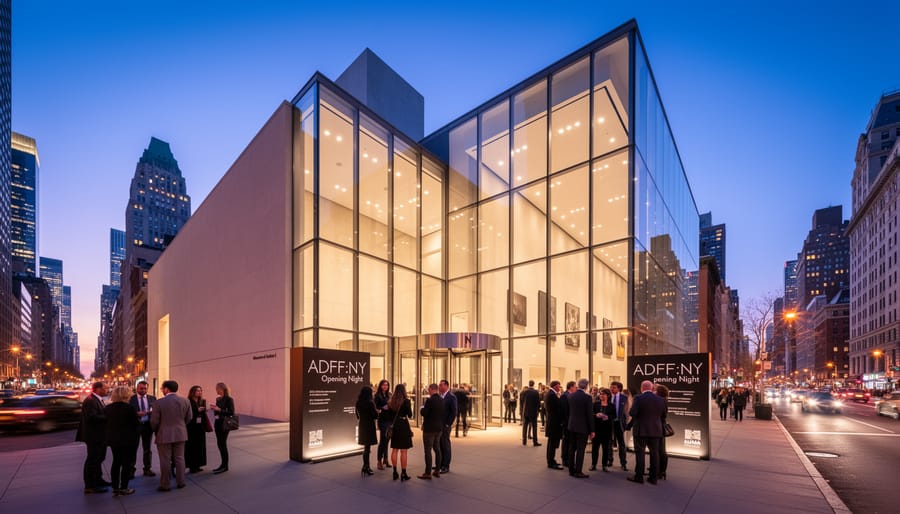
The Architecture and Design Film Festival: New York (ADFF:NY) anchors the global ADFF circuit as North America’s largest celebration of films exploring architecture, design, and urbanism. For the 2026/27 season, the festival returns to New York from October 12 through October 17, 2026, opening at the Museum of Modern Art (MoMA) before expanding to venues throughout the city. This flagship positioning reflects both the scale of its programming and its role as the launchpad for content that subsequently travels to ADFF’s other international cities.
What distinguishes ADFF:NY is its comprehensive approach to programming. The festival curates feature-length documentaries, short films, and experimental works that examine everything from iconic buildings and urban planning challenges to material innovation and the architects shaping contemporary practice. This breadth makes it valuable for architecture students seeking exposure to global design thinking, professionals tracking industry trends, and general audiences curious about the built environment. The programming typically balances established filmmakers with emerging voices, ensuring both polish and fresh perspectives.
The festival’s educational impact extends beyond screenings. Industry partnerships bring architects, designers, filmmakers, and critics into conversation through panel discussions and Q&A sessions, creating networking opportunities that connect academic learning with professional practice. For students, these interactions offer direct access to practitioners whose work they study in the classroom.
Filmmakers planning submissions should note that the festival will begin accepting entries for the 2026/27 season in January 2026, following the close of the 2025/26 submission window. This timeline allows adequate curation time for the October festival dates while giving creators several months to finalize and submit their work.
2. Architecture and Design Film Festival: Toronto (ADFF:Toronto)
Toronto’s ADFF chapter serves as the Canadian anchor for the global circuit, scheduled for November 4-7, 2026 in the 2026/27 season. The festival brings international architecture and design cinema to one of North America’s most architecturally diverse cities, where rapid urban development coexists with heritage preservation and ambitious public space initiatives.
What sets ADFF:Toronto apart is how it leverages the city’s design infrastructure. Toronto’s architecture community includes established practices, academic institutions like the University of Toronto’s John H. Daniels Faculty of Architecture, and a thriving creative sector. The festival taps into these networks, creating dialogue between visiting filmmakers and local practitioners who understand the challenges of designing for Canada’s harsh climate, multicultural neighborhoods, and evolving sustainability standards.
Programming reflects both global and regional priorities. While showcasing the same caliber of international work seen in New York or Mumbai, ADFF:Toronto contextualizes films against Toronto’s architectural realities: intensification debates, infrastructure renewal, and the tension between preserving character and accommodating growth. This localization makes abstract design concepts tangible for Canadian students and professionals seeking insights applicable to their own projects.
For those unable to attend ADFF:NY in October, the Toronto edition offers similar access to cutting-edge architecture film just weeks later, with the advantage of Canadian-specific industry connections and a more intimate venue scale that facilitates deeper conversations between attendees and visiting creators.
3. Architecture and Design Film Festival: Vancouver (ADFF:Vancouver)
ADFF:Vancouver brings the festival’s signature programming to Canada’s West Coast from November 10-15, 2026, anchoring its presence in a city where architecture and environmental stewardship are fundamentally intertwined. Vancouver’s built environment reflects urgent conversations about density, sustainability, and resilience, themes that resonate throughout the festival’s film selections and discussions.
The city’s architectural identity provides distinct context for this iteration of ADFF. Vancouver faces unique challenges: seismic risk, a temperate rainforest climate, and some of North America’s most constrained urban geography. These conditions have pushed local practitioners toward innovative building techniques, mass timber construction, passive house standards, and green infrastructure integration, that make Vancouver a living laboratory for sustainable design. The festival reflects this reality by showcasing films that examine how climate-responsive architecture can meet social needs without compromising livability.
ADFF:Vancouver also strengthens cross-border dialogue within the Pacific Northwest design community. Practitioners in Seattle, Portland, and Vancouver share similar environmental pressures and regulatory frameworks, creating a regional design language that transcends national boundaries. The festival attracts audiences from across the Cascadia corridor, fostering exchanges that acknowledge both local specificity and shared regional concerns.
For students and professionals in Vancouver’s robust design schools and practices, the November dates offer an accessible entry point to international architectural discourse. The festival translates global innovation into frameworks directly applicable to the region’s evolving architectural challenges, from densification strategies to reconciliation-informed placemaking.
4. Architecture and Design Film Festival: Los Angeles (ADFF:LA)
Los Angeles brings a distinctive dimension to the ADFF circuit, positioning architecture and design film at the crossroads of Hollywood’s filmmaking culture and the West Coast’s innovative design scene. The city’s deep roots in cinema production elevate the festival’s technical and narrative standards, films screened here benefit from an audience fluent in cinematography, editing, and visual storytelling, pushing architectural content toward the production values of feature documentaries.
ADFF:LA attracts a hybrid audience that traditional architecture festivals rarely reach. Design professionals from Southern California’s sprawling built environment mingle with film industry creatives exploring the scaffolding meaning of architecture in visual media, from production designers seeking authentic spatial narratives to documentary filmmakers interested in built-environment subjects. This convergence creates networking opportunities absent from purely design-focused events, where conversations span construction techniques, screen representation, and the business of architectural storytelling.
The festival’s West Coast location also extends ADFF’s geographic reach beyond its New York hub. For students and professionals in California, Arizona, and the Pacific states, ADFF:LA provides regional access to international architecture film without cross-country travel, making the festival circuit more inclusive while showcasing Los Angeles’s own architectural evolution, from mid-century modernism to contemporary sustainable development, as a living backdrop to the programming.
5. Architecture and Design Film Festival: Mumbai (ADFF:Mumbai)
ADFF:Mumbai extends the festival’s mission to South Asia, creating a vital platform for cross-cultural design exchange in one of the world’s fastest-growing metropolitan regions. The Mumbai edition brings carefully curated international architecture films to audiences navigating some of the most complex urbanization challenges globally, while simultaneously showcasing South Asian design innovation to the broader ADFF network.
The festival addresses themes particularly resonant in the Indian subcontinent: adaptive reuse of heritage structures, high-density housing solutions, infrastructure development at unprecedented scale, and climate-responsive building practices. By presenting these regional narratives alongside international programming, ADFF:Mumbai helps local professionals and students contextualize their work within global architectural discourse while demonstrating South Asian solutions to worldwide audiences.
For architecture students and professionals unable to travel to North American editions, the Mumbai festival offers comparable access to cutting-edge architectural storytelling and industry dialogue. The programming often highlights projects that balance traditional building wisdom with contemporary technology, reflecting India’s unique position bridging vernacular practices and rapid modernization. This makes the festival particularly valuable for those interested in sustainable urbanism and culturally-grounded design approaches.
The Mumbai edition also complements online professional learning by providing in-person community building and networking opportunities within South Asia’s growing architecture and design sectors, fostering connections that extend beyond the festival itself.
6. Other Notable International Architecture Film Festivals
Beyond the ADFF global circuit, several independent architecture film festivals contribute to a diverse international landscape. The European festival scene includes London’s Architecture Film Festival, which focuses on UK and European design narratives, and Architektur Film Fest in Vienna, which pairs screenings with architect-led discussions. In Asia, the Architecture Film Festival Singapore examines tropical design challenges through documentary storytelling, while the Danish Architecture Film Festival in Copenhagen emphasizes Scandinavian minimalism and sustainability.
These independent festivals often adopt distinct programming philosophies that differ from multi-city networks. Some prioritize experimental filmmaking over mainstream documentaries, while others integrate workshops and design charettes alongside screenings. This diversity of approach matters because it broadens the film festival impact on architectural discourse, ensuring that different regional perspectives and storytelling methods receive platforms.
For students and professionals, this variety creates multiple entry points based on geographic location, thematic interest, or preferred format, whether attending physically or accessing digital programming where available.
How to Make the Most of These Festivals
Getting the most out of an architecture and design film festival requires thoughtful planning and active engagement. Rather than passively watching screenings, approach the festival as a curated learning opportunity that can directly inform your work, expand your network, and expose you to design thinking you won’t find in textbooks or trade magazines.
Start by reviewing the full program when it’s released, typically six to eight weeks before the festival opens. Identify films that align with your current projects, research interests, or knowledge gaps. If you’re working on adaptive reuse, seek out documentaries exploring heritage preservation. If you’re grappling with sustainable materials, prioritize films showcasing innovative building systems. The best festival experience comes from intentional selection, not trying to see everything.
- Arrive early to screenings for optimal seating and to chat with other attendees before the lights dim.
- Take notes during Q&A sessions; filmmakers often share behind-the-scenes insights and production contacts.
- Attend opening and closing receptions where cross-disciplinary networking happens organically.
- Connect festival themes to your coursework or projects within the week, the ideas are freshest then.
- For filmmakers: begin preparing your submission materials in late 2025 for the 2026/27 season opening in January 2026.
Many architecture schools recognize festival attendance for continuing education credits, so check with your institution before you go and save your ticket receipts. Professionals should inquire whether their licensing board accepts film festival participation for required learning hours, some do, particularly when you can demonstrate direct application to practice.
If you’re a filmmaker, understand that submission windows open months before the festival dates. For the 2026/27 ADFF season, submissions begin in January 2026 for festivals running from October through November of that year. Budget time for a strong submission: a compelling synopsis, technical specs, and a rough cut that represents your final vision.
Frequently Asked Questions
What types of films are typically shown at architecture and design festivals?
These festivals showcase documentaries exploring architectural movements and iconic buildings, profiles of influential architects and designers, films examining urban planning challenges, experimental works on spatial design, and student projects. Programming ranges from feature-length documentaries to short films, covering both historical retrospectives and cutting-edge contemporary work.
When should filmmakers submit for the 2026/27 ADFF season?
The festival will begin accepting submissions for the 2026/27 season in January 2026. Submissions for the current 2025/26 season are now closed, so anyone planning to submit should prepare materials early in 2026 for consideration in the October cycle.
How do the different ADFF cities differ from each other?
While all ADFF cities share core programming from the global circuit, each adapts content to reflect local architectural context and design communities. The festivals occur sequentially, with New York opening the season in October, followed by Toronto and Vancouver in November, allowing the same films to reach diverse audiences with city-specific programming additions.
Are these festivals accessible to architecture students?
Yes, architecture and design film festivals actively welcome students and often offer discounted tickets or student passes. They provide valuable exposure to global design thinking, networking opportunities with professionals, and inspiration for academic projects, making them worthwhile educational experiences beyond the classroom.
Most architecture film festivals balance accessibility with professional depth, offering programming that serves everyone from undergraduate students encountering design films for the first time to seasoned practitioners seeking fresh perspectives. Virtual access options vary by festival and year, so checking individual festival websites closer to event dates provides the most current information on hybrid or online viewing opportunities.
Architecture and design film festivals represent far more than screening events. They serve as critical intersections where visual storytelling meets the built environment, transforming complex architectural concepts into accessible narratives that resonate across disciplines and borders. These festivals preserve design history, document evolving architectural discourse, and create spaces where students, practitioners, and enthusiasts can engage with ideas that shape our physical world.
The 2026/27 season, with ADFF:NY opening October 12 at MoMA and continuing through the global circuit in Toronto, Vancouver, Los Angeles, and Mumbai, offers renewed opportunities for engagement. Whether you attend as an audience member seeking inspiration, a filmmaker preparing to submit when the 2026/27 window opens in January 2026, or a professional looking to expand your network, these festivals provide tangible value that extends beyond the screening room.
Visual storytelling has become indispensable in making design thinking accessible. In an era where architecture increasingly addresses urgent challenges from climate adaptation to social equity, these festivals ensure that vital conversations reach wider audiences. They remind us that architecture isn’t confined to blueprints and buildings, it lives in the stories we tell about the spaces we inhabit and the futures we design.